
| Categories | Ship Towing Equipment |
|---|---|
| Surface treatment:: | sandblasting to S2.5 + one layer of epoxy shop primer, Polished, Galvanized, customized surface treatment available. |
| Weight:: | 29 to 1391 kg; |
| Nominal Diameters:: | 150 to 600 mm; |
| Classification Certificates:: | CCS, NK, BV, ABS, DNV-GL, LR, KR, IRS, RS, Etc. |
| Price: | Based on quotation |
| Brand Name: | Zhongyuan Marine Equipmen |
| MOQ: | 1 Unit |
| Payment Terms: | T/T, L/C |
| SWL Range:: | 98-1893 KN (Towing), 54 KN- 1401 KN (One Rope Use); 49-948 KN (Two Rope Use); |
| Model Number: | Standard or Customized |
| Supply Ability: | Customized production based on project requirements |
| Technical Standard:: | ISO 13795:2020; |
| Delivery Time: | Based on project requirements |
| Place of Origin: | China |
| Certification: | CCS, NK, BV, ABS, DNV, LR, KR, IRS, RS, RINA, CRS, Makers Test Certificate |
| Packaging Details: | Export standard pallet or customized packing |
Welded Steel Double Bitt Bollard with Compact Base Plate | ISO 13795 Type A for Ship Mooring and Towing
Product Overview
The ISO 13795 Type A welded steel double bitt bollard is a compact-base deck fitting used for ship mooring and towing arrangements. It is installed on a reinforced deck foundation and is selected together with the vessel mooring and towing plan, rope lead direction, one-rope / two-rope use, towing eye-splice arrangement, deck welding detail, and classification requirement.
This page is prepared for Type A welded steel bollards with a compact base plate according to the supplied ISO 13795:2020 product data. The structure uses two welded steel posts, a compact base plate, fins for keeping the mooring or towing line as low as practicable, and an eye plate for tying a stopping-off rope or chain. The supplied table covers nominal sizes from 150 to 600, with A/B variants for several sizes. Final SWL marking, deck reinforcement, weld detail, and certificate scope should be confirmed according to the project drawing and class procedure.
Quick Specifications
Main Technical Parameters
|
| |||||||||||||||||||||||||||||||||||||||||||||||||||||||||||||||||||||||||||||||||||||||||||||||||||||||||||||||||||||||||||||||||||||||||||||||||||||||||||||||||||||||||||||||||||||||||||||||||||||||||||||||||||||||||||||||||||||||||||||||
Selection & Inquiry Guide
Step 1: Confirm ISO 13795 Type A welded steel bollard with compact base plate and the required nominal size from Dn 150 to Dn 600.
Step 2: Confirm whether the bollard is used for mooring, towing, or both; identify one-rope mooring use, two-rope mooring use, or towing eye-splice arrangement.
Step 3: Confirm required SWL, actual rope lead angle, rope type, rope diameter, bollard layout, and whether A/B variant selection is required for the nominal size.
Step 4: Confirm deck foundation, deck reinforcement, weld leg, installation space, and whether the fins and stopping-off eye plate match the shipyard arrangement.
Step 5: Confirm material grade, steel tube or plate-formed post route, surface treatment, NDT / inspection scope, certificate requirement, and class witness requirement before quotation.
Step 6: Provide quantity, vessel type, application position, GA drawing or deck arrangement drawing, delivery destination, required delivery time, and reference photos if available.
Structure
Double welded steel posts | Compact base plate | Rope-control fins | Stopping-off eye plate | Deck welding interface | Weldable steel plate / steel tube post | Smooth rope-contact edges | Shop primer or specified surface treatment
Mooring, Towing & Fabrication Advantages
Custom Attributes
How It Works
Mooring or towing line approaches the bollard → Rope is arranged in figure-of-eight belay or towing eye-splice connection → Fins help keep the line low on the post → Load is transferred through the welded posts, compact base plate, welds, and reinforced deck structure → SWL marking, inspection, and coating are completed according to project requirement
Applications
Sea-going vessels | Cargo ships | Bulk carriers | Tankers | Container vessels | Tugboats | Workboats | Ship mooring stations | Ship towing arrangements | Newbuilding and replacement projects
Certifications & Advantages
Certificates can be arranged according to project requirement, inspection scope, material traceability, and class society approval procedure.
Certification: CCS, NK, BV, ABS, DNV, LR, KR, IRS, RS, RINA, CRS, Makers Test Certificate.
Drawing & Photos
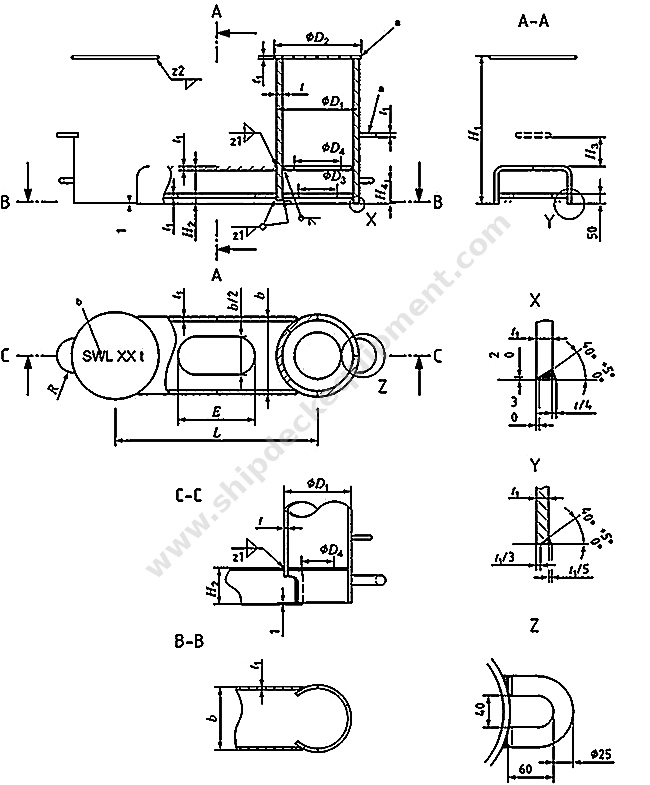

FAQ
Q1: Is ISO 13795 Type A bollard suitable for both mooring and towing?
A1: Yes, the supplied product data separates mooring-purpose and towing-purpose SWL values. The actual use should follow the vessel arrangement, rope connection method, deck foundation, and final SWL marking agreed for the project.
Q2: What is the difference between one-rope use, two-rope use, and towing use?
A2: One-rope and two-rope use refer to mooring-purpose figure-of-eight belay arrangements. Towing use refers to the towing eye-splice arrangement. These load cases should not be mixed, and the correct SWL should be selected according to the project drawing and operation condition.
Q3: What information is needed before quotation?
A3: Confirm ISO 13795 Type A, nominal size and A/B variant, mooring or towing load case, required SWL, material grade, surface treatment, quantity, certificate requirement, deck arrangement drawing, delivery destination, and required delivery time.

|
 Bulwark Mounted Panama Chock | DIN 81915 Form A Cast Steel Rope Guide for Ship Towing
DIN 81915 Type D Deck Mounted Cast Steel Horn Chock | Ship Mooring and Towing
Deck-Mounted Cast Steel Mooring Chock | DIN 81915 Type C, SWL 10 to 320 kN
Marine Guide Roller for Towing Rope, Wire Rope and Chain Guidance
OCIMF SPM Chafing Chain for Tanker Bow Mooring | 1000–2000 kN
JIS F 2030 Type A Single Point Mooring Chock | Oval Bow Bulwark Rope Guide
JIS F 2030 Bulwark Mounted Chock For Single Point Mooring Ship Towing Equipment
Deck-Mounted Ship Towing Bracket with Sliding Pin | JIS F 2029 Emergency Towing Fitting
Recessed Ship Towing Bitt | Steel Plate Fabricated Type B for Side-Shell Installation (ISO 13798)
Conical Pedestal Roller Fairlead | DIN 81907 Form B, 80–320 kN
Bulwark Mounted Panama Chock | DIN 81915 Form A Cast Steel Rope Guide for Ship Towing
DIN 81915 Type D Deck Mounted Cast Steel Horn Chock | Ship Mooring and Towing
Deck-Mounted Cast Steel Mooring Chock | DIN 81915 Type C, SWL 10 to 320 kN
Marine Guide Roller for Towing Rope, Wire Rope and Chain Guidance
OCIMF SPM Chafing Chain for Tanker Bow Mooring | 1000–2000 kN
JIS F 2030 Type A Single Point Mooring Chock | Oval Bow Bulwark Rope Guide
JIS F 2030 Bulwark Mounted Chock For Single Point Mooring Ship Towing Equipment
Deck-Mounted Ship Towing Bracket with Sliding Pin | JIS F 2029 Emergency Towing Fitting
Recessed Ship Towing Bitt | Steel Plate Fabricated Type B for Side-Shell Installation (ISO 13798)
Conical Pedestal Roller Fairlead | DIN 81907 Form B, 80–320 kN


